Climate Capital Weekly
Where is the money going? This week: Seoul hands fossil fuels a cheaper price, Beijing prepares the world's first biodiversity taxonomy, and a South African green hydrogen fund closes ZAR 3 billion.

Chart of the week!
Or table, this week. A collateral framework is the least glamorous document a central bank publishes and one of the most consequential. It sets what a bank can pledge for cash, and what that pledge is worth. Mark an asset down and borrowing against it gets more expensive.
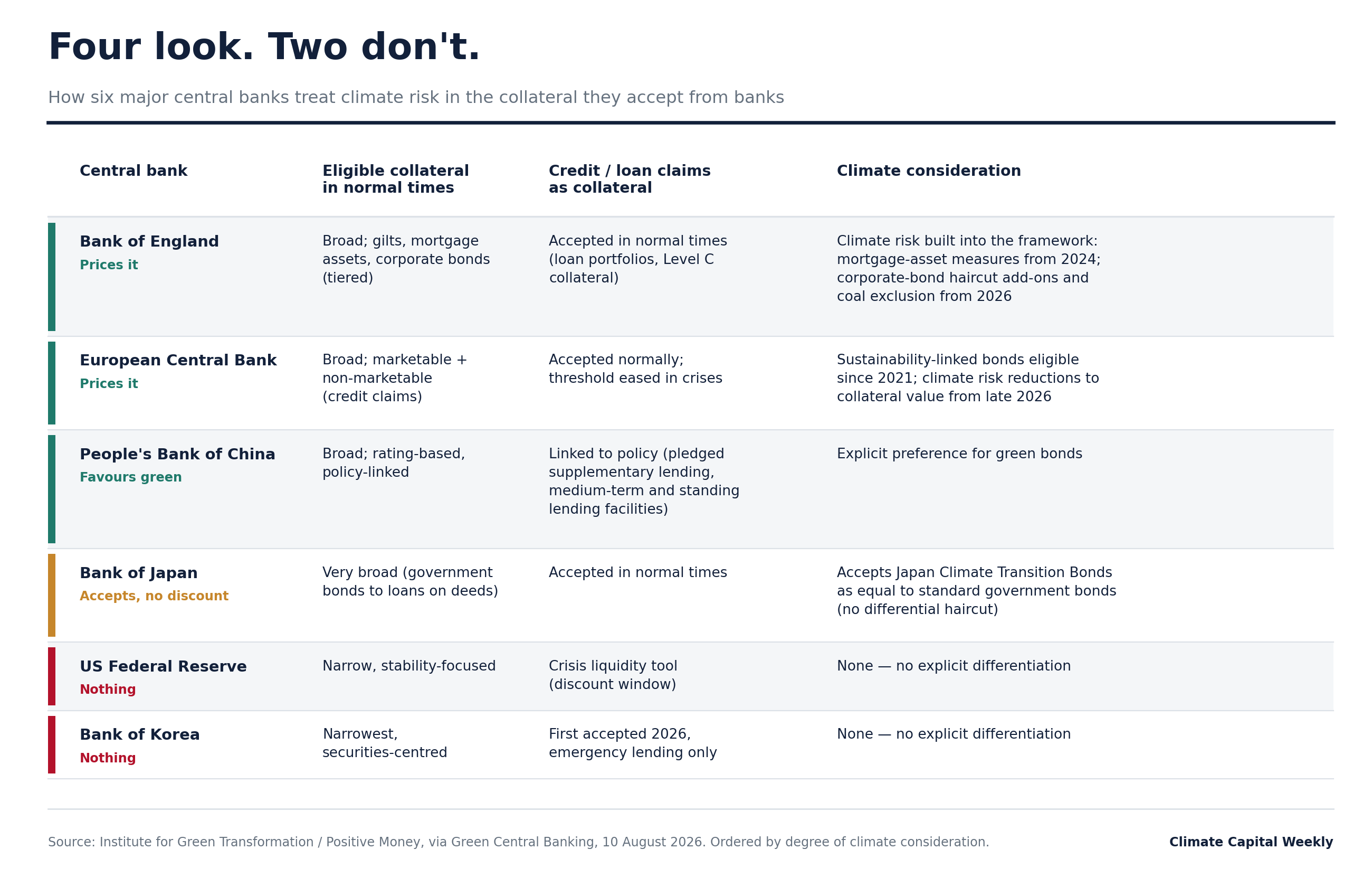
Asia audits what its central banks are actually funding
Asia spent this week doing something more interesting than announcing money: counting where the existing money already sits. Collateral pools, loan catalogues and carbon-price thresholds are not press-release material. They are, however, the mechanisms that decide which projects clear.
Seoul’s collateral pool has a carbon tilt nobody chose: Over half the bonds pledged as collateral at the Bank of Korea come from fossil fuel and high-emission sectors, while green and sustainability bonds account for less than 2% and the green share actually pledged is stuck around 0.4%, according to a new report from the Institute for Green Transformation and Positive Money. Between 2021 and 2025, fossil and high-emissions collateral pledged rose sixfold while green and sustainability bonds rose at half that rate.
China moves to put biodiversity in the catalogue: The People's Bank of China is set to finalise its biodiversity finance taxonomy this year after piloting across 26 provinces and municipalities since 2025, Green Central Banking reported on 5 August. The draft catalogue runs to 87 activities across four categories—sustainable use of natural resources, conservation and restoration, nature-based solutions, and environmentally-friendly activity in highly sensitive industries—each with a small number of measurable indicators so that, as one source put it, "bankers do not need to be ecologists." Former PBoC chief economist Ma Jun says it "may be the first biodiversity taxonomy in the world," and expects it to go mandatory after a pilot period.
The forest carbon price gap gets measured, and it is enormous: A study in Nature Communications covered by Eco-Business on 4 August analysed 3,754 logging, oil palm, timber and rubber concessions across Cambodia, Indonesia, Malaysia and Myanmar, and found roughly 42 million hectares of intact forest still standing inside them. To make conservation outcompete commodity production, carbon would need to price between US$33 and US$1,677 per tonne. Southeast Asian avoided-deforestation credits traded at roughly US$5–12 in mid-2026, per the World Bank's 2026 State and Trends of Carbon Pricing. Losing that forest means around 1.2 gigatonnes of CO₂ over three decades, i.e., about 20% of all industrial CO₂ emissions across the 11 ASEAN countries between 2000 and 2023. The authors' fix is a stack: blended finance, green bonds, payments for ecosystem services, biodiversity credits. Matthew Struebig, a conservation scientist at the University of Kent in England who was not involved in the research, said “regulatory barriers must be overcome if conservation is to become a reality in concessions. Without regulatory reform that allows companies to re-categorise their land, even the highest carbon price in the world won’t convince a company to risk their underlying land tenure”
EMEA supervisory ambition outpaces capital commitment
The ECB is embedding transition risk in collateral valuation, the UK is halving its international climate finance, and European asset managers are closing sustainable funds at roughly five times the rate they launch them. Regulatory infrastructure is consolidating faster than the capital base it is designed to govern.
The ECB puts a number on its climate factor, and extends it to the segment that matters: The Governing Council announced it will extend the climate factor in the Eurosystem collateral framework to non-financial corporate credit claims— bank loans— which make up 29% of pledged collateral. (The collateral framework is the rulebook for what a bank can pledge as security when it borrows cash from the central bank, and how much that security is deemed to be worth. Mark an asset down and the bank borrows less against it.) Until now the factor applied only to non-financial corporate bonds, under 2% of the pool. As Banque de France economist Carlos Mateo Caicedo Graciano observed, the newly covered segment is around seven times larger than the one already in scope. The extension to loans applies from 2027 while the factor on corporate bonds is already live.
Britain is halving the thing it asks everyone else to scale: The UK's pledge of "around £6bn" of international climate finance over three years, announced 19 March, replaces the previous £11.6bn commitment across 2021–2026. Carbon Brief's analysis puts the real cut at roughly 50% once inflation and the government's "creative accounting" adjustments are stripped out — against an officially reported 14% reduction. It is the backdrop to the WRI findings below: as traditional donors retreat, South-South finance is growing into the space, and reproducing the same neglect of the poorest countries. The COP29 goal of US$300bn a year by 2035 assumes the opposite trajectory.
Meanwhile the sustainable fund industry is shutting products faster than it opens them: Global product development in sustainable funds hit a record low in Q2 2026. Europe recorded 13 launches against 64 closures, a near five-to-one liquidation ratio, while the US logged three launches against 22 closures, per Morningstar data reported by the World Economic Forum on 12 August. Two forces are doing the work: higher rates have punished capital-intensive sectors like renewables, leaving the MSCI ACWI SRI Index at 56% against its broader benchmark's 65% over five years and tighter regulatory scrutiny in Europe and the UK has made generic ESG claims a compliance liability rather than a marketing asset. But read the flows, not the fund count. Capital is moving out of blanket equity screening and into targeted fixed-income and passive transition strategies, increasingly into structures that finance decarbonisation inside heavy industry, energy, steel and transport, rather than divesting from it.
Africa: one fund actually closed
Africa’s climate finance story is usually a launch. This week it was a close — and a reminder of who the money still isn’t reaching.
Green hydrogen gets ZAR 3 billion and an institutional signature: Climate Fund Managers announced first close of the SA-H2 Fund (Climate Investor Three South Africa) on 6 August at ZAR 3.0bn, about US$182m. The structure is very interesting! A Development Tranche of early-stage risk capital and technical assistance to carry projects to Final Investment Decision (FID), plus blended Equity Tranches from financial close through construction. Development Tranche anchors are Invest International, the European Commission via Global Gateway, and the Industrial Development Corporation of South Africa (IDC); Equity Tranche commitments came from the Public Investment Corporation on behalf of the Government Employees Pension Fund, Sanlam Life, Invest International and the Commission, with support from the DBSA. Target is ZAR 12bn by mid-2028. Two development funding agreements are already signed, a wastewater-to-green-methanol plant in Gauteng and the Hive Hydrogen Coega green ammonia project. The notable line item is the PIC: a South African public pension fund taking equity risk in domestic green hydrogen. Concessional capital did its actual job here, which is to be the thing institutional money stands on rather than the thing it replaces.
South-South climate finance tripled: A new WRI working paper, covered 6 August, finds voluntary climate finance from 14 major non-Annex II countries exceeded US$102bn between 2013 and 2023, peaking above US$17bn in 2023— against US$132.8bn from developed countries that year. China leads at US$44.8bn, then South Korea (US$13.9bn) and India (US$8.3bn). Excluding China, these providers put around 53% of their flows into adaptation and crosscutting projects since 2020, versus roughly 25% from developed countries in 2016–21. Here is the sting: excluding multilateral contributions, just 8% of that finance reached low-income countries and about half of that 8% went to a single country, Ethiopia, via large Chinese infrastructure loans. Emerging-market and developing economies excluding China need an estimated US$3.2tn a year by 2035.
And the gap keeps arriving as a bill, not a budget line: Months after floods swept Mozambique from late December into early 2026, Gaza province is facing what Al Jazeera called the second disaster on 7 August: hunger. Wells, livestock, gardens and roads destroyed; markets shut; the World Food Programme reporting “significant pressure on food prices driven by a dramatic reduction in supply.” Every dollar of resilient water, storage and road capacity not financed before the flood turns up afterwards as humanitarian and food-import spend, at a worse exchange rate and with no asset at the end of it.
So what?
The week’s developments point to a widening gap between the institutional machinery of climate finance and the capital actually moving through it. Supervisors are extending climate and nature risk into the core mechanics of bank funding: the European Central Bank will apply its climate factor to 29% of the Eurosystem collateral pool, and the People’s Bank of China is preparing to convert a biodiversity lending catalogue from pilot to standard. Neither takes effect immediately. The ECB’s expanded factor applies from 2027, and Beijing’s taxonomy is expected to become mandatory only after a further period of experimentation. Over the same window the capital base contracted: European sustainable fund closures ran at close to five times launches, and UK international climate finance was cut by roughly half in real terms.
Maybe we can expect this divergence to widen before it narrows. Rulemaking is cheaper than disbursement and, in the current fiscal environment, more politically durable. The practical consequence is that the cost of high-carbon assets will continue to rise through supervisory channels like collateral haircuts, disclosure obligations, capital treatment, while the concessional and grant capital needed to build the alternatives continues to be withdrawn.
The more useful signal this week was structural rather than fiscal. SA-H2 closed because its capital was tranched by risk stage rather than pooled, with concessional money absorbing pre-construction risk and institutional money entering behind it. China’s approach to biodiversity lending rests on the same logic applied to definitions: reduce the assessment burden on the lender and volume follows. And the Southeast Asian concession study located the binding constraint on forest finance in land tenure rules rather than in the carbon price. In each case the limiting factor was instrument design, not stated ambition. We expect the strongest returns by mechanisms that do not reinvest the wheel! The structures exist, they just need to be put into motion.
That’s all folks, thanks for reading!
Sources
Green Central Banking, Bank of Korea urged to stop ‘implicit subsidy’ to fossil fuels, 10 August 2026 (collateral composition >50% fossil/high-emission vs <2% green; 0.4% green share pledged; 7.2% vs 11.8% average haircuts; sixfold increase in fossil collateral 2021–2025) — https://greencentralbanking.com/2026/08/10/bank-of-korea-urged-to-stop-fossil-fuel-subsidy/
Institute for Green Transformation / Positive Money, Securing the Future: Bank of Korea (underlying report) — https://positivemoney.org/uk-global/publications/securing-the-future-bank-of-korea/
Green Central Banking, China set to finalise biodiversity taxonomy, 5 August 2026 (87 activities across four categories; 26 provinces piloting since 2025; Ma Jun on first-in-world status and likely move to mandatory) — https://greencentralbanking.com/2026/08/05/china-set-to-finalise-biodiversity-taxonomy/
Eco-Business / Mongabay, Carbon markets alone won’t keep Southeast Asia’s forests standing: report, 4 August 2026 (3,754 concessions across Cambodia, Indonesia, Malaysia, Myanmar; ~42m ha intact forest; required carbon price US$33–1,677/t vs US$5–12/t mid-2026 per World Bank; ~1.2 Gt CO₂ over 30 years ≈ 20% of ASEAN industrial CO₂ 2000–2023; Struebig on tenure and re-categorisation) — https://www.eco-business.com/news/carbon-markets-alone-wont-keep-southeast-asias-forests-standing-report/
European Central Bank, ECB to extend use of climate factors in Eurosystem collateral framework to non-financial corporate credit claims, 24 July 2026 (extension to credit claims; 5% maximum reduction; application from 2027) — https://www.ecb.europa.eu/press/pr/date/2026/html/ecb.pr260724_4~f082ce289d.en.html
Green Central Banking, ECB expands its climate factor to shield the EU from climate-related shocks, 27 July 2026 (non-financial corporate bonds under 2% of pledged collateral vs credit claims at 29%; segment ~7x larger per Caicedo Graciano) — https://greencentralbanking.com/2026/07/27/ecb-expands-climate-factor/
Carbon Brief, Analysis: UK is ‘halving’ its climate finance for developing countries, 27 March 2026 (£6bn over three years announced 19 March, replacing £11.6bn across 2021–2026; ~50% real cut once creative accounting is excluded, against 14% officially reported) — https://www.carbonbrief.org/analysis-uk-is-halving-its-climate-finance-for-developing-countries
Reuters, Sustainable fund launches stutter amid industry caution, 4 August 2026 (Morningstar data: Europe 13 launches vs 64 closures; US 3 vs 22; record-low global product development in Q2 2026) — https://www.reuters.com/business/environment/sustainable-fund-launches-stutter-amid-industry-caution-2026-08-04/
World Economic Forum, Wildfires and the rising cost of climate risk, and other finance news to know, 12 August 2026 (MSCI ACWI SRI Index 56% vs 65% benchmark over five years; shift to fixed income, passive transition and heavy-industry decarbonisation strategies) — https://www.weforum.org/stories/financial-and-monetary-systems/wildfires-rising-financial-cost-of-climate-risk-and-other-finance-news-to-know/
European Commission, DG International Partnerships, Climate Fund Managers reaches first close of SA-H2 Fund at ZAR 3 billion, 6 August 2026 (ZAR 3.0bn ≈ US$182m; Development and Equity Tranche structure; EC/Global Gateway, Invest International, IDC, PIC on behalf of GEPF, Sanlam Life, DBSA; ZAR 12bn target by mid-2028; Green Efuels Producers and Hive Hydrogen Coega agreements) — https://international-partnerships.ec.europa.eu/news-and-events/news/scaling-green-transition-southern-africa-under-global-gateway-climate-fund-managers-reaches-first-2026-08-06_en
World Resources Institute, Beyond the Usual Suspects: Assessing Climate Finance from the Largest Non-Annex II Economies (working paper) — https://www.wri.org/research/beyond-usual-suspects-assessing-climate-finance-largest-non-annex-ii-economies
Green Central Banking / Dialogue Earth, As new sources of climate finance grow, the poorest are neglected, 6 August 2026 (US$102bn 2013–2023, peak >US$17bn in 2023 vs US$132.8bn developed-country finance; China US$44.8bn, South Korea US$13.9bn, India US$8.3bn; ~53% adaptation/crosscutting ex-China vs ~25% OECD 2016–21; 8% to low-income countries, roughly half to Ethiopia; US$3.2tn annual need by 2035 ex-China) — https://greencentralbanking.com/2026/08/06/as-new-sources-of-climate-finance-grow-the-poorest-are-neglected/
Al Jazeera, After the floods, hunger: Mozambique’s second disaster, 7 August 2026 (Gaza province; destroyed wells, livestock, farmland; WFP on food price pressure) — https://www.aljazeera.com/news/2026/8/7/after-the-floods-hunger-mozambiques-second-disaster